
By Matt Vaadi, Founder, Underdog Digital · Host of the Payrollin’ Podcast
Picture a business owner three blocks from your office. She’s on hold with a 1-800 number again. Her rep changed again. She’d switch tomorrow.
She has never heard your name.
So when she finally gets fed up, she asks for three quotes from three companies that all sound the same. And she picks the cheapest one. Not because price matters most. Because price is the only thing left to compare.
The short answer: To market payroll services without competing on price, pick a niche the nationals can’t talk to, write one message for it, and reach those owners every month with outreach, a website that wins the comparison and founder content. When they get fed up, you’re the name they already know. Price only decides deals nobody decided first.
That’s the whole game. The rest of this post is how to run it, built from what we run inside our own payroll and PEO company and for the bureaus we work with through our marketing for payroll companies system.
Key takeaways
- Buyers fall back on price when every pitch sounds the same. Being specific is the cure.
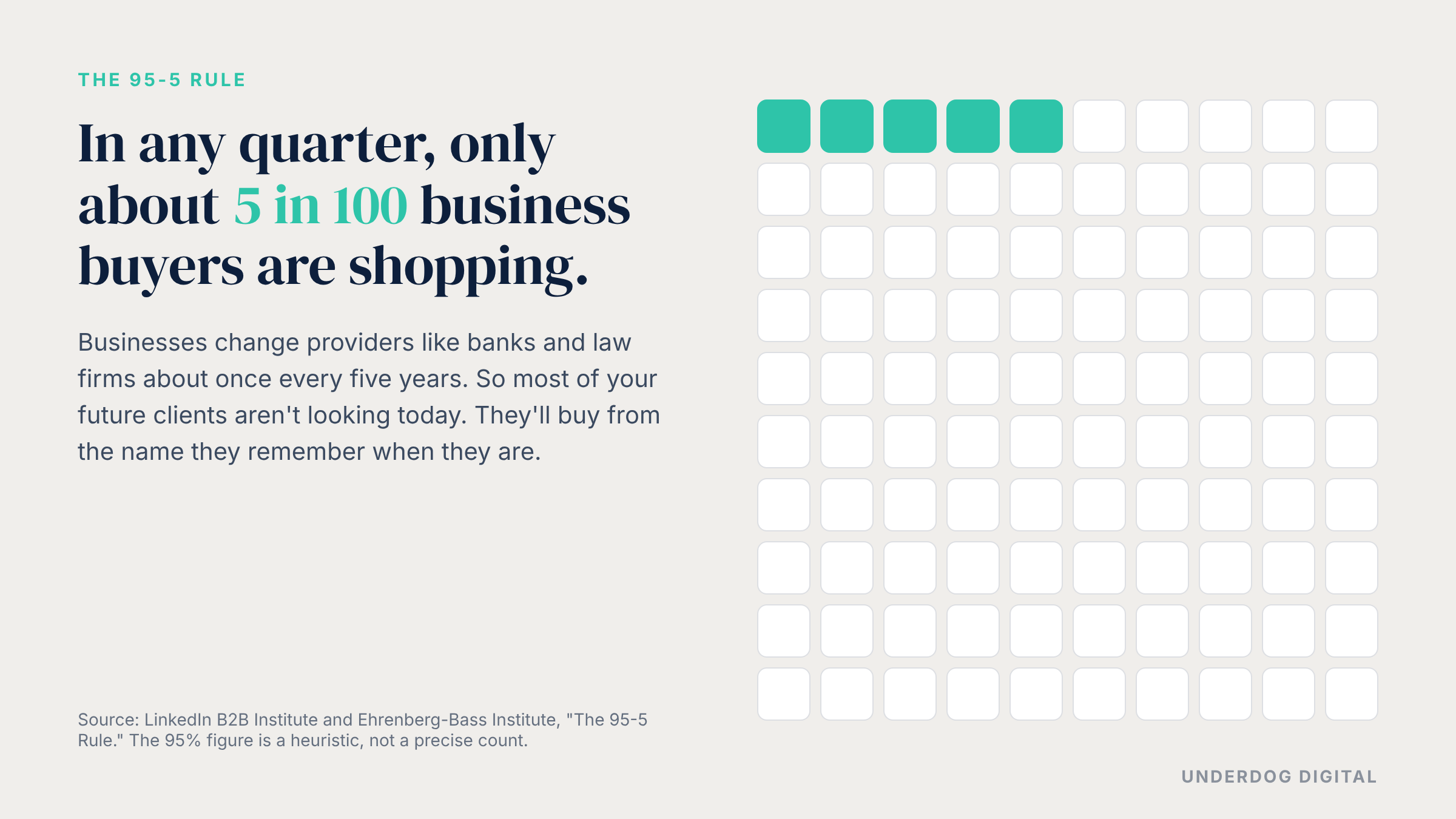
- Most of your future clients aren’t shopping today. Roughly 5 in 100 business buyers are in market in a given quarter.
- Sell the switch, not the software. Owners leave over hold times and rep turnover, so make leaving feel safe.
- Run outreach, your website and founder content together, every month. One channel alone stalls.
- Cutting price is a margin trap. The math below shows why.
Why do payroll buyers default to price?
Buyers default to price when nothing else about the options looks different. If three bureaus all promise “accurate, on-time payroll and great service,” the owner can’t tell them apart. So she compares the one number she can. A lower quote doesn’t fix that. It just teaches the buyer that price is how this decision gets made.
Read your own homepage. Then read two competitors’. If you could swap the logos and nobody would notice, you’re in a price fight before the first call.
The nationals don’t win on price. They win on being known.
ADP and Paychex don’t have to be the cheapest quote to win. They win because the owner has heard of them. When a buyer is nervous about getting payroll wrong, a familiar name feels safe.
Here’s the research behind that. The LinkedIn B2B Institute and Professor John Dawes of the Ehrenberg-Bass Institute call it the 95-5 rule. Businesses change providers for services like banking about once every five years. So only about 5% of buyers are in market in a given quarter. The other 95% will buy later, from whatever name comes to mind first.
Payroll fits that pattern. Nobody switches payroll for fun. They switch when something breaks. Your marketing job is to be the name they remember on that day.
How do small payroll companies compete with ADP and Paychex?
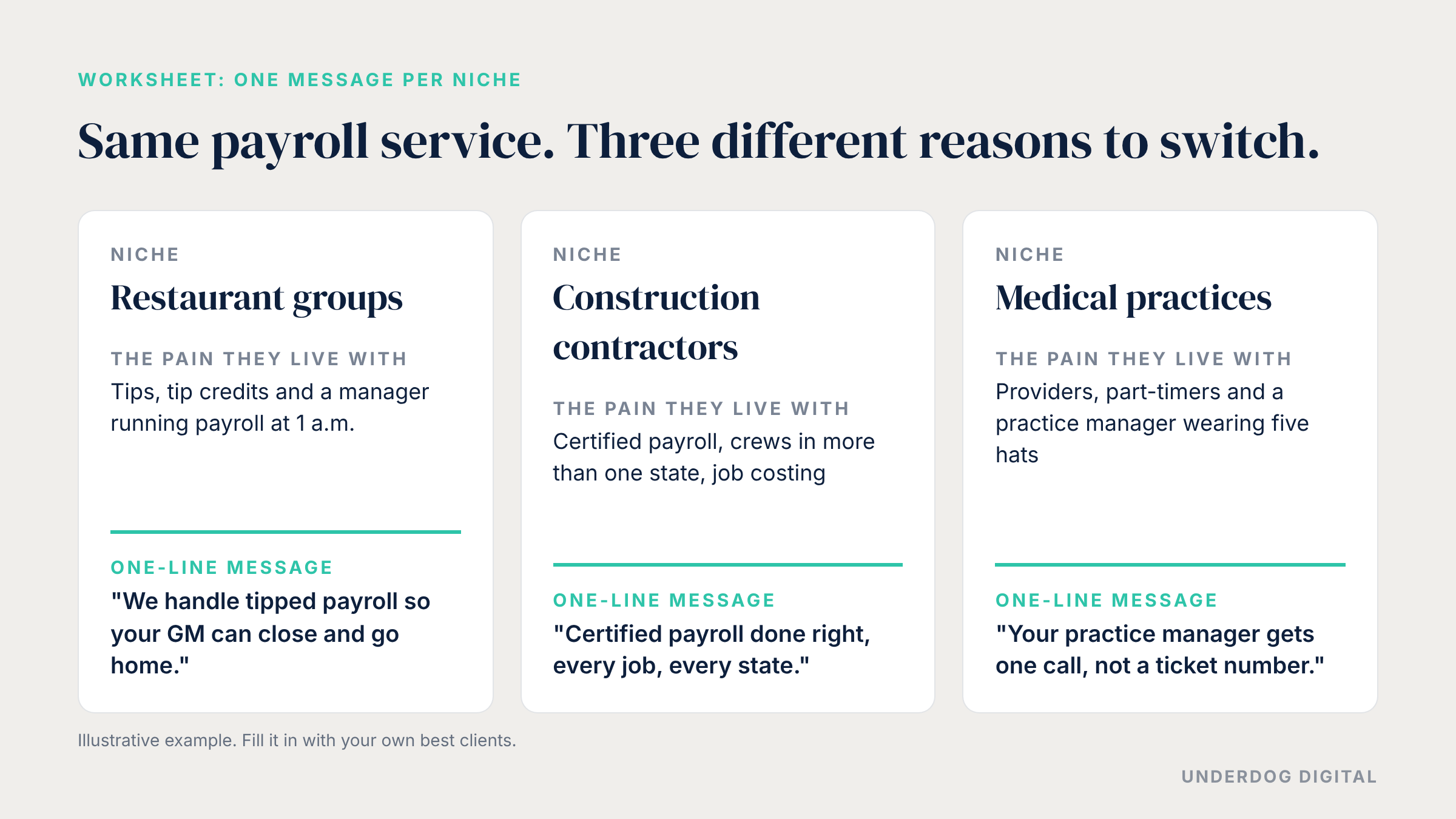
Small payroll companies compete with ADP and Paychex by being specific where the nationals have to be general. Pick two or three industries you serve better than anyone. Speak to their exact problems, show proof from businesses like theirs and offer a named person instead of a ticket number. A national can’t do that for every niche. You can.
Choose your ELF clients
We use a simple filter with every payroll company we work with. Your best clients are ELF: Easy, Lucrative and Fun.
- Easy: they send clean data, pay on time and don’t fight every change.
- Lucrative: enough employees, enough services, and they stay for years.
- Fun: you like them, and your team likes working with them.
Pull your client list and circle the ten best by that standard. Then look for what they share. Industry. Headcount. A software they all use. A pain they all had before they found you. That pattern is your niche.
Write one message per niche, not one message for everyone
A message for everyone is a message for no one. Here’s an illustration of what one service could sound like written three ways.
Selling co-employment too? That’s a different buyer conversation. Our PEO marketing system is written for that buyer, and our HR firm marketing work covers bureaus that bundle payroll with HR and benefits.
What makes a business owner finally switch payroll providers?
In my experience running a payroll company, owners rarely switch to save money. They switch when something breaks: a wrong paycheck, a tax notice, a new rep again, another hour on hold. Then they look for someone who makes the move feel safe. So name those moments in the owner’s words and show exactly how switching works.
Sell the switch, not the software. Every bureau has software. Not every bureau tells the owner what happens on day one.
Make switching feel safe
Fear of the switch is the real competitor. Payroll mistakes cost money, and owners know it. The IRS failure-to-deposit penalty starts at 2% of the unpaid deposit when payroll taxes are 1 to 5 days late. It climbs to 10% after 15 days.
So spell out the switch in your marketing, before anyone asks:
The “safe switch” checklist for your website and sales deck
- Who their named contact is, with a photo and a direct line
- What happens in week one, step by step
- How you handle prior quarters and year-end forms
- When the best time to switch is (and what if it’s mid-year)
- What they need to send you, in one short list
- How fast a real person answers the phone
How do you get in front of owners before they’re ready to switch?
You get in front of owners before they switch by showing up on a schedule, not when you remember. Run targeted cold email and LinkedIn outreach to the niches you picked, follow up past the first message and post on the founder’s LinkedIn every week. When something finally breaks, you’re already in their inbox and feed.
That matters because buyers do most of the work alone. Gartner found that B2B buyers spend only 17% of their buying time meeting with potential suppliers. That’s all suppliers combined, not just you.
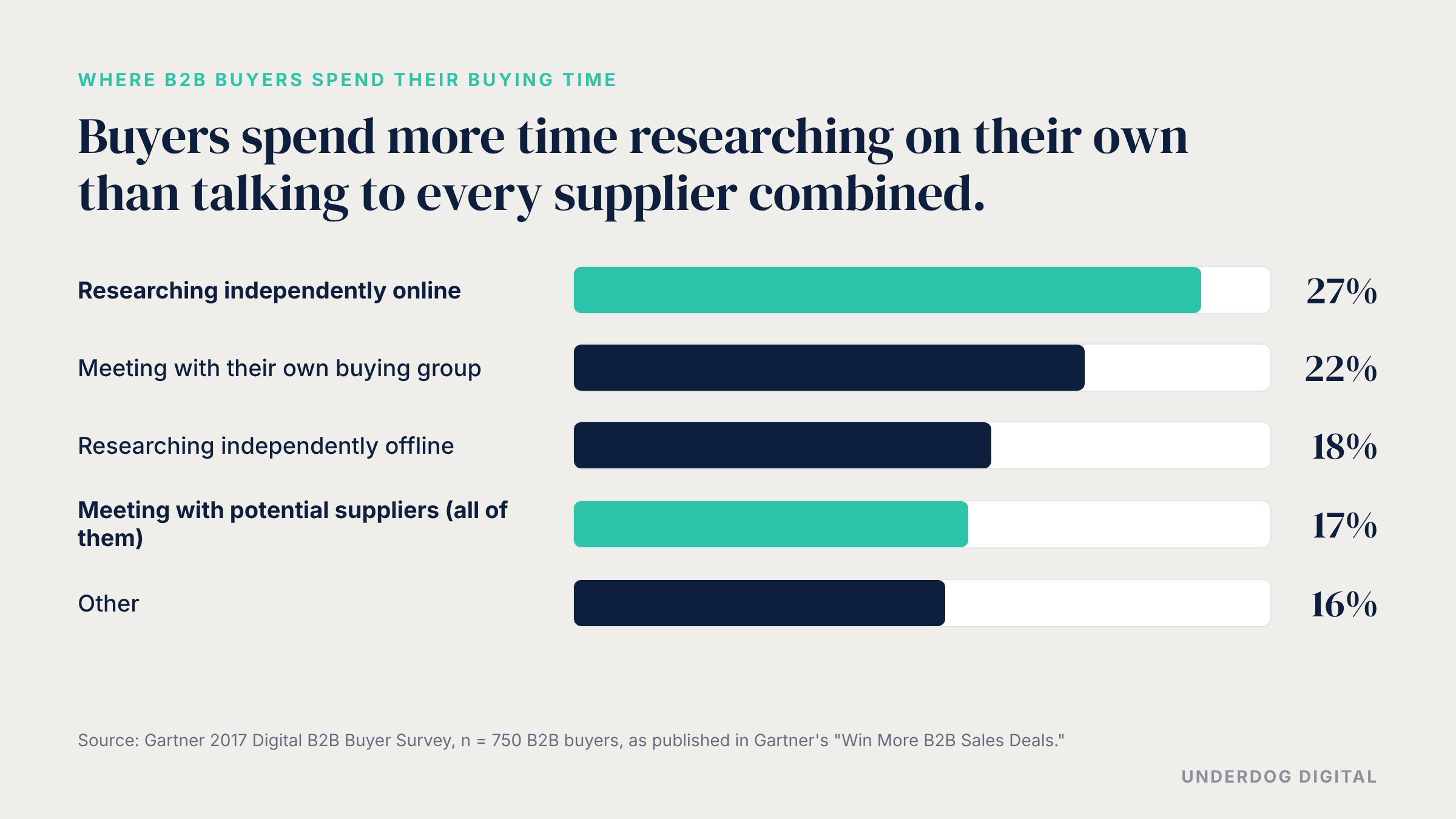
That study covers B2B buyers broadly, not only payroll buyers. But anyone who has lost a deal they never heard about knows the feeling.
Does cold email work for payroll companies?
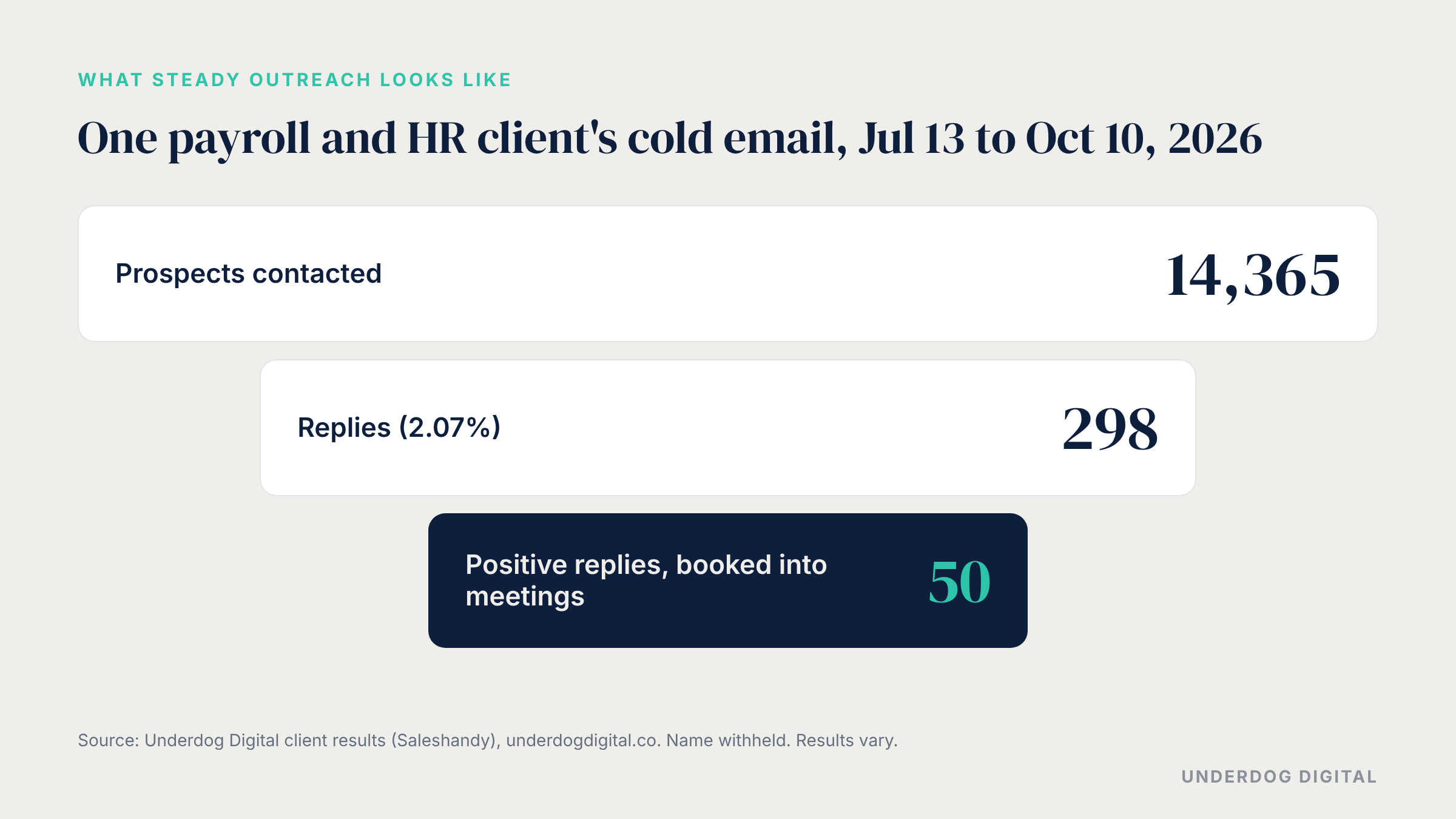
Yes, when it’s aimed at a niche and written for owners who are already frustrated. One payroll and HR client we work with contacted 14,365 prospects from July 13 to October 10, 2026. That produced 298 replies (2.07%) and 50 positive replies that turned into booked meetings. Send from separate warmed-up domains and follow the CAN-SPAM rule.
Here’s what a niche message looks like in practice. Short. About them. One easy question.
What this looks like: a first cold email to a restaurant group owner
Subject: payroll for your three locations
Hi Dana,
Running tipped payroll for three locations usually lands on one manager, late at night, after close.
We’re a local payroll company in your area. We handle tips and multi-location payroll for restaurant groups, and every client gets one named person who picks up the phone.
Worth a 15-minute call to see if we’d make your GM’s week easier?
(Illustrative template, not a real send. Use your own niche, proof and contact name.)
Follow up like you mean it
Most replies don’t come from the first email. Plan three to five touches across a few weeks, each one adding something new: a short tip, a quick case, a question. Our outbound lead generation services run this for payroll buyers, and email automation keeps it going for people who said “not now.”
LinkedIn works the same way. In LinkedIn outreach for a payroll and HR client, 17.3% of connection requests were accepted (80 of 462), and the reply rate was 21.1%.
Become the bureau owner people recognize
Founder content is the slow, steady part. Post on your personal LinkedIn every week about what you see in payroll: the mistakes, the tax deadlines, the switch stories (anonymized). This is the out-of-market 95% at work. You’re building memory for later.
It can also pry loose an existing relationship. In the 2024 Edelman and LinkedIn B2B Thought Leadership Impact Report, 70% of C-suite leaders said a piece of thought leadership at least occasionally made them question whether to keep working with an existing supplier.
“I run a marketing agency, and I barely talk about marketing. I talk about the payroll industry, because that’s where I live.”
Matt Vaadi, Founder, Underdog Digital
Our Thought Leadership pillar turns one content interview into posts in your voice, so it doesn’t eat your nights.
What should a payroll company’s website do to win the comparison?
Your website should make the owner feel understood in five seconds and safe in sixty. Name the pain in the headline, show who you serve, prove it with numbers or reviews, explain the switch and put one clear next step above the fold. Then make sure it ranks locally and answers questions plainly so AI tools can quote it.
Every referral and every cold email ends the same way. The prospect checks out your website. If it looks like the last bureau’s, you’re back to comparing quotes.
Get found for “payroll services near me” and in AI answers
Local search still starts at Google. Google says local results are mainly based on relevance, distance and prominence, and prominence includes reviews and links to your site. So keep your Google Business Profile complete and keep asking happy clients for reviews.
45% of US consumers said they used ChatGPT or other AI tools for local business recommendations in 2026, up from 6% a year earlier.
AI is now part of the search too. That number comes from BrightLocal’s Local Consumer Review Survey 2026. It’s a consumer survey, not a payroll-buyer survey. Still, it tells you where search is headed. Google says its AI features use the same SEO basics as regular search, with no extra technical requirements. In our experience, a direct 40 to 60 word answer under a question heading is the easiest thing for those tools to quote.
Our SEO marketing services work covers both. One small payroll company we work with now ranks top 3 locally on Google for 7 keywords, including “payroll services.”
Is your payroll website winning the comparison or losing it? The free Website Grader scores your homepage out of 30 on our 10-point checklist and shows you what to fix first. Grade My Website
How do payroll companies get CPA referrals?
Payroll companies get CPA referrals by making the CPA look good and making their life easier. Show that you return calls fast, send clean reports, handle year-end cleanly and never step on their tax and advisory work. Then stay in touch on a schedule. A CPA who sees your name monthly is more likely to say it.
What a CPA needs to hear before they refer you:
- “You won’t get blamed.” Their reputation rides on your service.
- “Your client stays yours.” You do payroll. They keep the tax and advisory work.
- “Your year-end gets easier.” Clean reports, on time, in the format they want.
- “Here’s who to call.” One named contact, not a support queue.
Then put CPAs on your outreach and content list like any other niche. One referral relationship is luck. Ten is a channel.
“A referral is a thank-you note, not a growth plan. Nice when it shows up. Terrible thing to bet your firm on.”
Matt Vaadi
Should a payroll bureau lower its prices to win clients?
Usually, no. A price cut comes straight out of margin on every check, for as long as that client stays. It also attracts the buyers most likely to leave for the next lower quote. Match a price only for a great-fit client with a small gap. Walk away from deals that are about price and nothing else.
Here’s the math most bureaus skip. Use your own numbers.
Mini calculator: how many more clients does a price cut need?
To earn the same gross profit after a price cut, you need this many more clients:
Extra clients needed = price cut ÷ (gross margin minus price cut)
| Your gross margin | Price cut | Extra clients needed just to break even |
|---|---|---|
| 40% | 5% | 14% more |
| 40% | 10% | 33% more |
| 30% | 10% | 50% more |
Example margins for illustration, not industry benchmarks. Plug in yours.
A 10% cut at a 40% margin means you need a third more clients to stand still. That’s a lot of new business just to earn what you earn today.
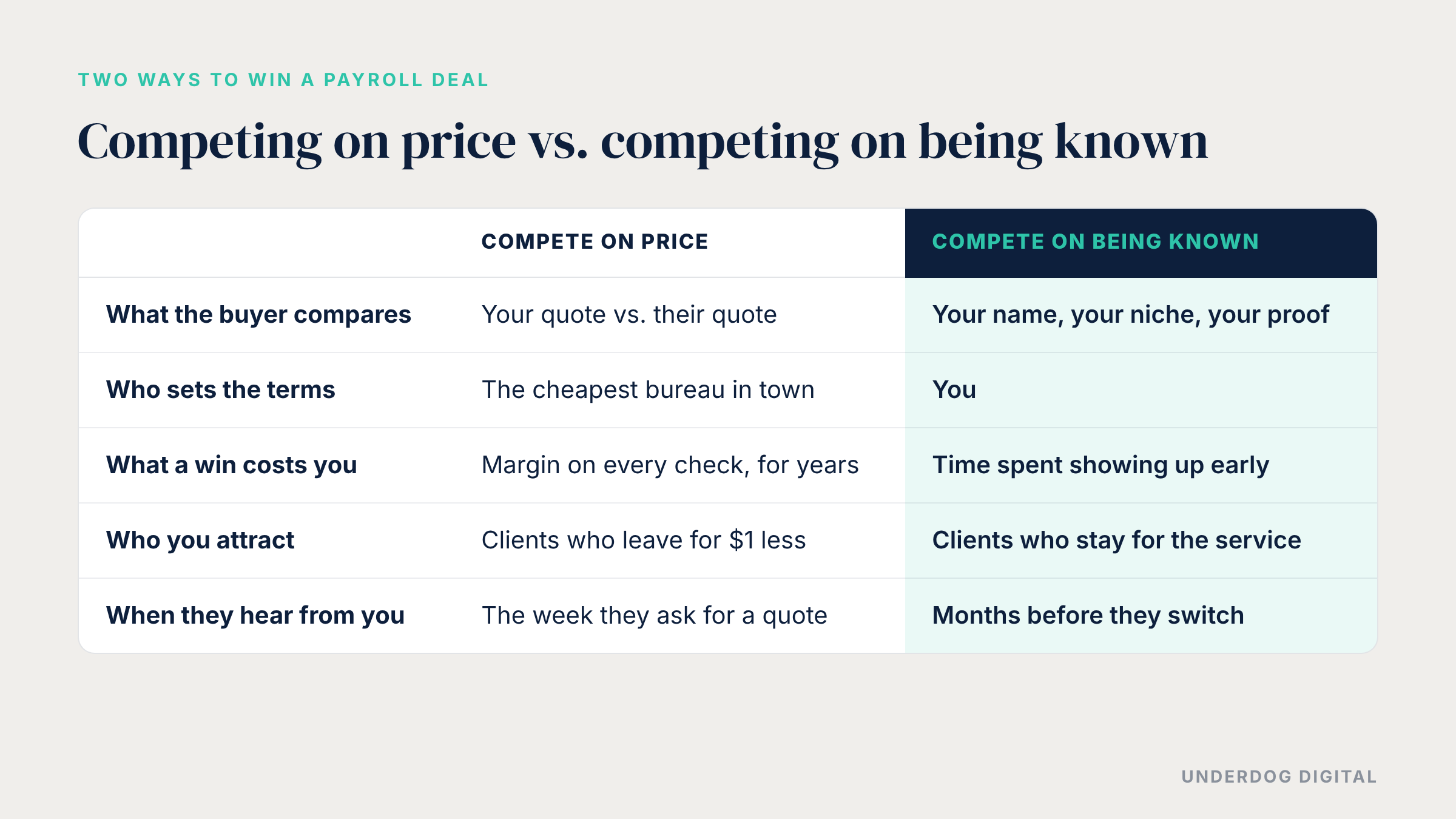
Some deals really are price-only. The owner wants the lowest number and nothing else. Let the nationals and the discounters have those. You want the clients who stay for the service.
What does this look like in real numbers?
The system works when it runs every month. Here’s what that looks like for payroll and HR businesses on our live client results page:
| Result | What happened | Source |
|---|---|---|
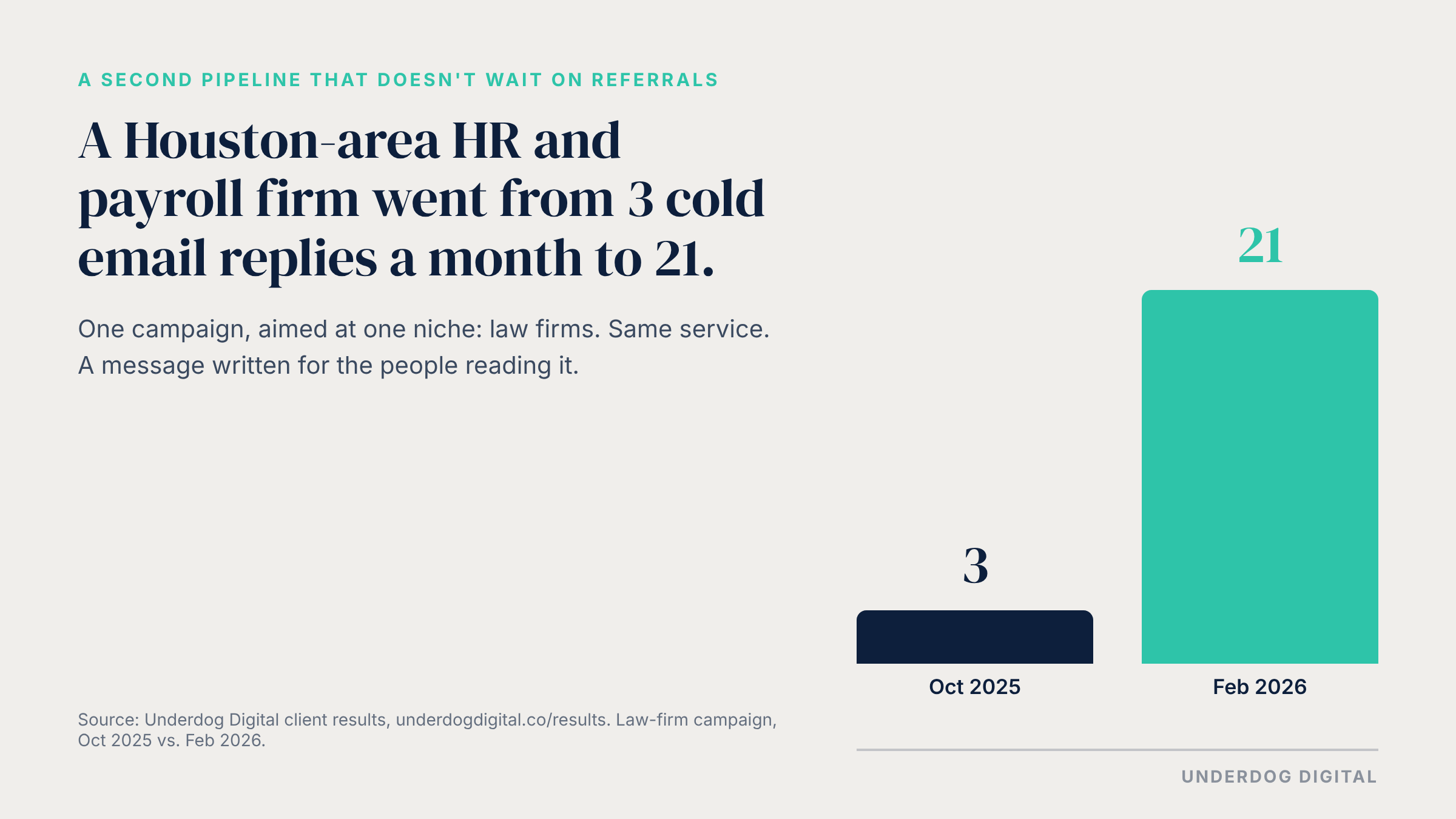
| 7x cold email replies | A Houston-area HR and payroll firm went from 3 replies a month (Oct 2025) to 21 (Feb 2026) on a law-firm campaign | /results/ |
| 50 booked meetings | 14,365 prospects contacted, 298 replies, 50 positive replies (Jul 13 to Oct 10, 2026) | Payroll page, /results/ |
| 50+ leads a month | guHRoo, our own payroll and PEO company, across all its sources | Payroll page |
| Top 3 locally | A small payroll company’s site ranks top 3 locally for 7 keywords, including “payroll services” | Payroll page |
None of that came from cutting price. It came from being specific and showing up.
How to market payroll services: FAQ
How do you market payroll services when every competitor looks the same?
Stop looking the same. Pick two or three niches, write one message for each, and prove it with numbers or reviews from clients like them. Then reach those owners every month with outreach, a clear website and founder content, so you’re the familiar name when they finally decide to switch.
How do payroll companies get more clients?
They pair referrals with a system that finds new buyers: niche cold email and LinkedIn outreach, a website built to convert and rank locally, and steady founder content. Referrals still close deals. They just shouldn’t be your only source of new clients. Our payroll page breaks down how we run all three.
Does cold email work for payroll companies?
Yes, when it targets a niche and speaks to owners who are already frustrated with their provider. One payroll and HR client we work with turned 14,365 prospects into 298 replies and 50 positive replies that became booked meetings in about three months. Send from warmed-up separate domains and follow CAN-SPAM.
Should a payroll bureau lower its prices to win clients?
Rarely. A price cut costs margin on every payroll for the life of the client, and it attracts buyers who leave for the next lower quote. At a 40% gross margin, a 10% cut needs about a third more clients just to break even. Compete on fit, service and trust instead.
How long until marketing brings in new payroll clients?
Nobody can honestly promise a date. Website fixes can start right away. Cold email needs 2 to 4 weeks of mailbox warm-up before it goes live. Founder content builds over months. The system gets stronger the longer all three run together.
Stop losing payroll clients to companies that don’t know their names
Get a free audit of your website, your outreach and your content. We’ll show you where the leads are going. You keep the report either way.
Not ready to talk? Grade My Website. Want more from the payroll industry? Listen to the Payrollin’ Podcast.